


DEHA course highlights "principals of sound body" for attaining holistic wellness. It presents the Material and Psychic aspects of the human body in 6 lessons based on Shrimad Bhagavad-Gita. First three lessons describe the elements of nature followed by the characteristics of the human body and mind. Next three lessons describe the sensory objects followed by the ways of controlling the senses and the consequences of sense gratification. In this course the participants shall learn the following. The basis of human existence on earth. The three kinds of food and their influence on the human body. The three main characteristics of the human mind. The two broad ways of conducting life in the material world. The characteristics of a balanced consciousness. The cause and effect of mental stress.
It is essential to obtain the specially designed transliteration textbooks and graphic workbooks for the successful completion of the PoornaYoga Self-Learning Program. Students should complete the following tasks using the textbook and workbooks.
Textbook tasks: The PoornaYoga Self-Learning textbooks are available in multiple transliteration scripts such as Devanagari, Bengali, Gujarati, Kannada, Malayalam, Oriya, Punjabi, Roman, Tamil, Telugu and Urdu covering over 33 world languages. Students shall scan the QR codes inside the textbook to access the Self-Learning videos to practice the Shloka recitation and understand the Shloka meaning.
Workbook tasks: The workbooks are designed to stimulate interest and facilitate learning through graphic illustrations and interactive learning tasks. Students shall add colours to the graphic illustrations and describe them in own words. Students shall copy-write shlokas and meanings from the textbook to workbook.
The course completion certificate is awarded by the ‘Gita Vidya Peetam’ after the successful completion of each of the four courses namely DEHA, GNANA, YOGA and JEEVA. After completing all the four courses the student is awarded with the “PoornaYoga certificate”. Students should fulfil the following tasks in the same order;

1. Scan QR codes inside the textbook to learn the recitation and understand the meaning of shlokas / sutras.
2. Fill colours and describe the graphics in the workbook.
3. Copy verses and meanings from the textbook to workbook.
4. After completing the above tasks, students should get their workbook validated by a certified GitaVidya Saha-BODHAK.
5.Saha-BODHAK shall verify the student workbook and grant a validation code and note the student details in his code book.
6. Saha-BODHAK shall email a legible scanned copy of thevalidation page of the student workbook to GitaVidya.org@gmail.com and receive the certificate by post
The course calendar is customisable to suit the convenience and fit the time zone of every individual or institution. Students/Teachers can download this editable course calendar and set the date and time of each E-Class to customise it. The customised course calendar can be implemented to pursue the course.
Planet earth is a wonderful creation with countless varieties of living creatures and non-living objects. In this lesson we learn about the creation and the creator. We will understand the material nature and three modes of material energy. We will distinguish the characteristics of human beings under the influence of different material energies.
Human body is driven by energy and the energy is generated by food. Different kinds of foods produce different types of material energy namely Sattvic, Rajasic and Tamasic. In this lesson we understand the influence of material energies on human body. We learn the ways to deal with the body for gaining balance in life.
The mind has no physical shape yet it controls most of our actions. In this lesson we discuss the characteristics of a human mind and its functioning. The mind when put under self-control behaves like a friend otherwise like an enemy. We explore the factors influencing mind and ways of controlling them.
Objects that attract senses are called the sense objects. Brain identifies such objects and Mind experiences joy or pain from them. In this lesson we discuss the composition of the material nature and categories of people engaging with it. We understand the influence of material nature and material energy on human actions.
One of the ways to deal with senses is to control them and reasonably enjoy the material nature. One who controls senses can gain stability in life. In this lesson we discuss the ways of sense control and its effect on human life. We explore the characteristics of “SthitaPragna” in other words the stable conscious.
The irrational way of dealing with senses and enjoying material nature with no limits and conditions is called sense gratification. One who fails to control senses will lose stability in life. In this lesson we discuss the consequences of sense gratification and its effect on human life. We explore ways to overcome the influence of material nature and gain eternal peace.
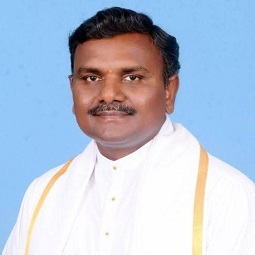
“Poorna Yoga Program” is designed and developed by Shri Gopi Venkateswara Prasad, to offer a broad understanding of Yoga, through graphic interpretation of 140 Gita-shlokas and 96 Yoga-sutras under 22 thematic lessons. Each lesson is structured with three components of learning namely Sadhana, Sodhana and Vaadana, to enable students understand, explore and apply the wisdom of Yoga in daily life. Gopi studied Yoga in its various forms since his childhood. His lifelong interest in Yoga Shastra led to the foundation of PoornaYoga Program in India, Europe and America. His experience in the field of Education has led to the creation of the G-Education model, which is applied in the development and dissemination of structured learning programs such as this one. Gopi has an ‘MBA in Global Management’ from Germany and a ‘Diploma in Physical Education’ from India. His interests include poetry, singing and spiritual art.
‘Gita Vidya Peetam’ had been offering the ‘PoornaYoga program’ in India, Europe and America since 2020 to distil the eternal wisdom of Bhagavad-Gita and Patanjali-Yoga under four courses namely DEHA, GNANA, YOGA and JEEVA. All four courses are available in a single textbook. Each course has a separate workbook. PoornaYoga textbook and workbook are essential to participate and complete the program. The textbook provides an introduction to the theory and free access to the E-Class videos. Workbooks enhance the understanding and examine the progress of the student through practical tasks and project work. After fulfilling the workbook tasks and project work students shall receive the PoornaYoga course completion certificate from the Gita Vidya Peetam.

Gita Vidya Ashram
394, 29th Ward, Chickkaballapur
Pincode 562101,
Karnataka INDIA
Email: GitaVidya.org@gmail.com
 DOCX
DOCX PDF
PDF